

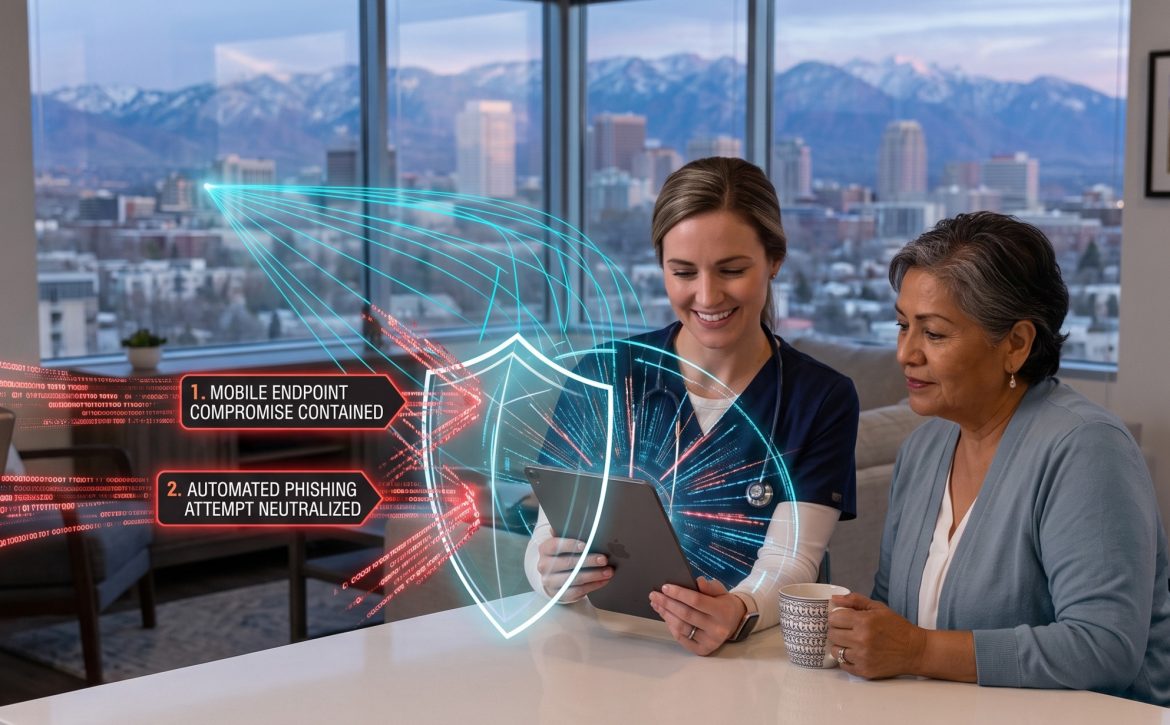
Securing the Mobile Clinician: A HIPAA Compliance Guide for Home Health and Hospice
By the CloudG Healthcare IT Team
Healthcare is no longer confined to the four walls of a hospital. Today, Home Health aides, Hospice workers, and traveling nurses deliver critical care directly in patients’ living rooms. To do this effectively, they rely on a constant flow of mobile data—accessing Electronic Health Records (EHR), sending secure messages, and updating patient charts on smartphones, tablets, and laptops.
But here is the harsh reality: mobile devices are the weakest link in healthcare cybersecurity.
According to recent data, healthcare breaches cost an average of $7.42 million per incident, and the industry has seen a massive 278% increase in ransomware attacks in recent years. If a mobile clinician’s unencrypted tablet is lost, stolen, or compromised on a public Wi-Fi network, it is not just an IT headache—it is a HIPAA violation that can financially devastate a post-acute care organization.
At CloudG, we believe that compliance shouldn’t slow down care. As a high-touch, U.S.-based Managed Service Provider, we specialize in securing the mobile workforce. Here is our guide to protecting your data, your clinicians, and your patients in the field.
The Risk: Why Standard Mobile Devices Violate HIPAA
The HIPAA Security Rule mandates that all Electronic Protected Health Information (ePHI) must be safeguarded. An off-the-shelf iPad or Android phone does not meet these standards out of the box.
When organizations fail to implement Mobile Device Security For HIPAA, they expose themselves to significant risks:
- Lost or Stolen Devices: A device without full-disk encryption and remote-wipe capabilities is a walking data breach.
- Shadow IT and Consumer Apps: Staff using standard SMS or consumer messaging apps (like WhatsApp) to discuss patient details are directly violating HIPAA protocols.
- Lack of Access Control: Devices without Multi-Factor Authentication (MFA) or short session timeouts allow unauthorized access if left unattended.
3 Steps to Secure Your Mobile Endpoint Devices
To protect your Home Health or Hospice agency, CloudG implements a comprehensive, human-led security program. Here is the 3-step framework we use to secure the continuum of care.
Step 1: Implement Strict Device Management (MDM)
You cannot protect what you cannot see. The foundation of mobile compliance is a centralized Mobile Device Management (MDM) strategy.
- Maintain an Inventory: Track every device (both corporate-owned and BYOD) that accesses ePHI.
- Enforce Encryption: Ensure full-disk encryption is active on all smartphones, tablets, and laptops.
- Remote Control: If a nurse loses a tablet in the field, CloudG can immediately issue a remote wipe command to destroy the ePHI before it falls into the wrong hands.
Step 2: Establish “Identity-First” Access & Containerization
We secure the data, not just the device.
- Secure Containers: We utilize containerization to keep clinical data (EHR apps, secure messaging) isolated from personal apps on the device. We block the ability to copy/paste ePHI into unapproved applications or personal cloud backups.
- Multi-Factor Authentication (MFA): We require MFA (such as a password combined with a push notification) for all access to ePHI systems. This is critical because compromised credentials are the leading cause of breaches.
Step 3: Proactive Monitoring and ITDR
Traditional antivirus is no longer enough to stop modern cybercriminals.
- Managed ITDR: CloudG utilizes Identity Threat Detection and Response (ITDR) to monitor how credentials are being used. If an attacker attempts to use a compromised clinician password from an unknown location, our 24/7 Security Operations Center (SOC) immediately isolates the account.
- Audit Trails: We enable logging for device activity and access to ePHI, fulfilling the HIPAA requirement for audit controls.
The CloudG Difference: Compliance That Enables Care
For Home Health and Hospice administrators, managing mobile IT can feel like a full-time job. It shouldn’t be.
When you partner with CloudG, you aren’t just getting software; you are getting an Outsourced CIO and a dedicated team of U.S.-based experts. We handle the heavy lifting of Mobile Device Management, encryption, and 24/7 monitoring, so your clinicians can focus on what matters most: delivering exceptional patient outcomes without the friction of IT pain.
Are your mobile clinicians fully secure? Don’t wait for a lost tablet to trigger an audit. Contact CloudG today to schedule a Free Healthcare IT Assessment. Let’s secure your mobile workforce together.